You click a single hexagon near the edge of the board, watch the cat shift one tile closer to freedom in response, and immediately understand that Trap the Cat is not going to let you win by clicking randomly. Every move you make teaches the cat exactly where not to go.
| Genre |
Turn-based logic puzzle |
| Board Layout |
Hexagonal grid with a center starting tile |
| Game Modes |
Story mode, Classic mode, User-Generated Levels |
| Win Condition |
Fully surround the cat so it has no open hex tile left |
The Hexagon Grid and Basic Rules
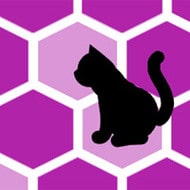
The setup is simple to explain: a black cat starts on a hexagon at the center of the board, and on each of your turns you click one open hexagon to block it permanently. After your move, the cat automatically shifts to an adjacent open tile, always choosing whichever path brings it closest to the edge. If it ever reaches the outer boundary of the board, it escapes and the round ends in a loss.
Beginners almost always make the same early mistake — clicking hexagons close to the cat’s current position instead of thinking about the board as a whole. Blocking a tile directly next to the cat feels productive, but it usually just nudges the cat toward a different open path rather than actually closing off its escape routes. The game rewards patience over aggression in a way that isn’t obvious until you’ve lost a few rounds watching the cat slip through a gap you didn’t account for.
Once you understand that the cat always takes the shortest route outward, the whole approach to a run changes. Instead of chasing the cat’s current position, stronger play means building a wide perimeter of blocked hexagons well ahead of where the cat is likely headed, then gradually tightening that perimeter inward.
Story Mode Versus Classic Mode Difficulty
Story mode structures its levels as a progression, with each stage introducing a slightly tighter board or a trickier starting position for the cat than the one before it. By the time you reach the later levels in this mode, the margin for error shrinks considerably, and a single misplaced hexagon early on can doom the entire attempt before you’ve even realized it.
Classic mode strips away that structure and instead offers straightforward easy, medium, and hard difficulty settings, letting you jump directly into whichever challenge level matches your current skill without working through a level sequence first. Community members who describe themselves as puzzle purists tend to gravitate toward Classic mode specifically because it removes any pacing decisions from the developer’s hands and puts the difficulty entirely in your control.
Players who enjoy building rather than solving eventually migrate toward the User-Generated Levels mode, where anyone can design a custom board layout and publish it for others to attempt. This mode has quietly become the place where the community trades genuinely difficult hand-crafted puzzles that go well beyond anything the built-in Story mode offers.
Reading the Cat’s Pathing
What experienced players talk about constantly is the moment a run clicks into place — when you stop reacting to the cat’s last move and start predicting its next three moves instead. This shift from reactive clicking to genuine forward planning is often described in community discussion as “thinking in hexagons,” a small piece of shorthand for treating the whole board as a single connected shape rather than a set of individual tiles.
Advanced players also learn to bait the cat deliberately, leaving one path open just long enough to draw it toward a section of the board that’s already mostly sealed off, then closing the final gap once it commits to that direction. This kind of deliberate misdirection isn’t necessary on easier boards, but it becomes close to essential once the grid opens up in Classic mode’s harder settings.
One thing players debate openly is how unpredictable the cat’s movement can feel on larger boards, even though it’s always technically choosing the shortest path outward. Some players find this tension exciting, arguing that it forces genuinely adaptive play, while others feel that unpredictability occasionally punishes a sound strategy through what feels like bad luck rather than a real mistake. Both views come up regularly whenever a hard-mode loss gets discussed.
What New Players Usually Ask
Whether User-Generated Levels affect your progress in Story mode is a common early question, and the answer is that they don’t — the two modes track progress completely separately, so experimenting with a difficult custom board never risks anything you’ve already unlocked in the story progression. Another frequent question is whether the cat’s movement is truly random or governed by a fixed rule, and it’s the latter: the cat always advances toward the nearest open edge tile, which means its behavior is entirely predictable once you learn to read the board the way it does.
A third question that comes up constantly among newer players is why a seemingly solid trap still fails on the final move. The most common cause is a single overlooked hexagon somewhere along the outer edge of the perimeter, since the cat only needs one uncovered path to slip through even after dozens of tiles have already been blocked correctly.
Trap the Cat rewards exactly the kind of patient, whole-board thinking its simple hexagon grid seems to discourage at first glance, and there’s a specific satisfaction in watching that clever black cat run out of open tiles after a run where every single click actually mattered.