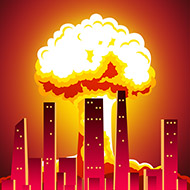
You drop a meteor on the cyberpunk skyline and watch the shockwave peel three towers sideways before they even finish falling. That’s the entire pitch of City Smash in one moment: no mission briefing, no countdown, just a city and whatever you decide to throw at it. The game hands you a sandbox and gets out of the way, which is exactly why so many players keep coming back to it between rounds of other things.
| Genre |
Sandbox destruction simulator |
| Platform |
Mobile and browser |
| Core Loop |
Select a disaster tool, unleash it on a city, watch physics resolve the damage |
| Player Count |
Single player |
Disaster Tools and What They Actually Do
The tool list in City Smash is longer than most sandbox games bother with, and each one behaves differently once it hits the ground. A black hole doesn’t just erase a building, it pulls surrounding debris and nearby structures toward the center before collapsing, which means placing one near a bridge tends to drag the whole span down with it. Missiles are the blunt instrument, cheap and reliable for punching through a single structure, while orbital lasers slice clean lines through anything in their path.
Then there’s the roster of creatures, which is where City Smash stops feeling like a physics toy and starts feeling like a monster movie. Giant gorillas punch and throw cars, kaiju models stomp through blocks leaving crushed streets behind, and Lovecraftian tentacles rise out of the ground to wrap around whatever’s closest. Tripods stalk on three legs and fire beams that ignite fires on contact, which chains into the game’s fire propagation system if you’re careless about aim.
Earthquakes deform terrain rather than just toppling buildings, tornadoes fling loose debris into other structures, and tsunamis sweep entire coastal blocks on the right map. Combining tools is where the game gets creative — cracking foundations with an earthquake before finishing with a tornado tends to produce far messier results than either tool alone.
Reading the Cyberpunk City and Coastal Town Maps
City Smash offers a handful of distinct settings, and the two discussed most in player communities are the cyberpunk city and the coastal town. The cyberpunk map is dense and vertical, packed with narrow streets that make chain reactions easy to trigger, while the coastal town spreads things out horizontally, rewarding tools like tsunamis and tornadoes that need open space to build momentum.
Players chasing quick, satisfying single-hit destruction gravitate toward the cyberpunk map’s density, while players chasing longer chain reactions usually prefer the coastal town’s layout. Neither map has a scoring system attached, so the appeal is purely about which kind of destruction each layout showcases.
Chain Reactions Nobody Tells You About
Once destruction escalates, City Smash lets building collapses trigger fires or secondary explosions on their own, without extra input from the player. This separates casual players from people who’ve spent real hours in the game: knowing a collapsing tower near a cluster of vehicles will keep going after the initial hit lands. New players usually treat each tool as one discrete action and miss that City Smash is simulating the aftermath continuously.
A common early mistake is spreading damage thin across a map instead of concentrating tools where infrastructure — roads, bridges, power lines — carries the chain reaction further on its own. After testing a few combinations, most players start deliberately targeting these connective points instead of individual buildings.
- Bridges collapse structures on both ends when the center span fails
- Fires spread faster between densely packed cyberpunk-map buildings
- Power failures can darken entire districts after a single well-placed hit
What Players Actually Argue About
The most common criticism aimed at City Smash isn’t the destruction itself but the lack of any objective layered on top of it. Some players want scoring, timed challenges, or a way to compare runs against friends, and feel the pure sandbox format runs out of steam after a few sessions. Others see that same openness as the entire point and argue that adding goals would ruin what makes the game work. It’s a genuine divide in the community, and City Smash hasn’t picked a side.
What is the best tool combination in City Smash?
There’s no single best combination, but players frequently pair an earthquake with a tornado to crack foundations first and then scatter the debris, or use a black hole near a bridge to pull down connected structures on both sides at once.
Does City Smash have a win condition or scoring system?
No. City Smash is built entirely as an open sandbox without objectives, timers, or scores, which is a deliberate design choice rather than a missing feature, though it remains one of the most debated aspects of the game among players.
Why do buildings sometimes collapse without being hit directly?
City Smash simulates structural stress across connected buildings, so a nearby explosion, a collapsing bridge, or a spreading fire can bring down a structure you never targeted, which is the chain reaction system working as intended.
What keeps people opening City Smash again isn’t a checklist of goals but the small unpredictable moments — the tentacle that wraps around a bridge just as a tornado tears through the next block over, or a kaiju stomping straight into a fire that started from your last missile. There’s no score attached to any of it, and that’s the whole reason it works.