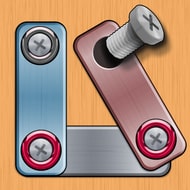
Nuts And Bolts looks like a fidget toy — a handful of screws pinning some metal plates to a board — but it plays like a logic puzzle that punishes careless clicking almost immediately.
The Only Rule: One Screw, One Slot
Every plate in Nuts And Bolts is held down by one or more screws, and every screw you remove has to go somewhere — an open hole on the board. There’s no removing a screw into thin air. That single constraint is the entire puzzle: you’re not solving a maze, you’re solving a sequencing problem where each move changes which moves are available next.
A plate falls away once every screw pinning it down has been cleared. Clear every plate, and the level ends. The rules stay this simple through dozens of early stages, which is exactly why the difficulty spike later on catches so many players off guard.
Casual players who treat the game as a relaxing tap-and-clear experience tend to do fine on the first chunk of levels, then stall hard once overlapping plates enter the picture. What trips them up isn’t the number of screws on a board — early boards can have plenty — it’s the fact that removing any single screw is irreversible unless you spend an undo, so a board that looked easy at a glance can quietly become unsolvable two taps in.
The interface reinforces this: you’re always shown exactly how many open holes remain, a small counter that experienced players glance at constantly, because that number, not the number of screws, is what actually limits your options.
Why Overlapping Plates Change Everything
Once two or three plates share the same board space, removing a screw doesn’t just free one plate — it can shift what’s underneath and block a screw you were planning to remove next. This is where slot management becomes the real skill in Nuts And Bolts: knowing not just which screw to pull, but which open hole to send it to, since a badly chosen destination can seal off a bolt you’ll need three moves later.
Players consistently describe getting stuck in the mid-game not because a level is unsolvable, but because they used their last open slot carelessly two moves earlier. An undo option exists precisely because this mistake is so common, and most experienced players use it the moment they see a “no future moves” situation forming rather than tapping around hoping something opens up.
Speedrun-minded players optimize for the fewest total moves per level, chasing what the community sometimes calls a clean solve — clearing a board without touching undo at all. Completionist players take the opposite approach, resetting a stage from scratch the instant they sense a mistake, since for them a clean solve matters more than finishing quickly. Meanwhile players just working through the daily challenge tend to be more forgiving with undo, treating it as a normal part of the puzzle rather than a failure.
Chain reactions are the detail that only becomes obvious after enough playtime: freeing one plate can expose a screw that was completely hidden a moment earlier, which means the board you’re looking at right now is rarely the full picture of the puzzle you’re actually solving. Recognizing when a single removal is about to cascade into three or four newly exposed screws, instead of just one, is what separates players who breeze through mid-game boards from players who keep hitting dead ends on the exact same layouts.
Power-Ups Solve Problems the Base Puzzle Won’t
When a board genuinely runs out of open holes, Nuts And Bolts offers tools like drilling an additional slot into the board, which effectively gives you one more move of breathing room on levels that would otherwise be unsolvable with the holes provided. This tool matters most on the overlapping-plate boards described above, where a single extra hole can be the difference between a screw sitting there uselessly and a chain reaction finishing the level.
It’s worth being upfront about the game’s most common complaint: ad frequency, and here player accounts genuinely diverge. Some reviewers describe reaching level 31 without seeing a single ad, praising the pacing outright. Others report an ad after nearly every level, sometimes two in a row, which for a puzzle this short-form can end up taking longer to sit through than the level itself takes to solve. That gap between accounts suggests the ad load isn’t identical for everyone, but it’s consistently the single most debated issue among players who otherwise enjoy the core puzzle.
Extra holes and undo are also where that same ad economy tends to surface most directly — reviewers note that using either tool is frequently the trigger point for an ad, which means cautious players start rationing undo not because they’re worried about the puzzle, but because they’re worried about the interruption.
Early in the game, none of this friction is obvious — levels take under a minute and the mechanics feel almost too simple. By the time boards start layering three or four plates on top of each other, the same one-screw-one-slot rule from level one is suddenly demanding real forward planning, which is the clearest sign the difficulty curve in Nuts And Bolts is doing its job. Once you’ve cleared a board that looked hopeless with two open holes left, the appeal of the whole system clicks into place: it was never about the screws themselves, it was always about the slots.
Nuts And Bolts never adds a second mechanic to complicate things — it just keeps stacking more plates onto the same single rule until you’re planning three moves ahead instead of one, watching for the next chain reaction before you’ve even made your current move, and that’s precisely the trick that keeps players coming back to just one more board.