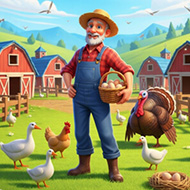
Eggstreme Farming looks like a cozy chore simulator from the store page, but it plays like a logistics test where forgetting one water trough can cost you an entire pen’s output for a day. The premise sounds gentle enough — collect eggs, sell trays, grow the farm — until a player realizes how unforgiving the timing actually is once more than one species is involved.
| Genre |
First-person farming simulator |
| Platform |
PC |
| Core Loop |
Manage feed and water, monitor bird health, collect and sell eggs, unlock expansion |
| Player Count |
Single player |
Feed Types and the Cost of Guessing Wrong
The current build of Eggstreme Farming limits players to two feed types, which sounds simple until different species start showing preferences that aren’t spelled out anywhere in the interface. Chickens tolerate a wider range of feed without visible consequence, but ducks and geese react faster to the wrong mix, showing slower egg output within a day or two if a player just grabs whatever’s cheapest at the store.
Most new players buy feed in bulk without checking which container needs refilling first, and end up with one species running low while another sits overstocked. Eggstreme Farming doesn’t flag this for you — it just lets output quietly drop until a player notices the pattern themselves, which is usually somewhere around the third or fourth in-game day.
By that point, most players have started treating feed purchases as a per-pen decision rather than a single farm-wide restock, buying just enough for each pen’s actual consumption instead of topping off everything at once. It’s a small shift, but it’s the difference between a farm that runs efficiently and one that’s constantly a day behind on supplies.
Reading a Bird’s Health Before It’s Too Late
Health in Eggstreme Farming isn’t shown as a hovering bar the way it is in a lot of other farming games — a player has to actually walk the pens and notice when a bird looks off before reaching for medicine. This design choice is one of the more divisive things players bring up in discussions about the game: some find it an immersive touch that rewards attention, others find it an unnecessary layer of guesswork stacked on top of an already busy daily routine.
Medicine only helps once a decline has actually started, so administering it early based on a hunch does nothing — the game expects players to catch a real drop, not a suspected one. Waiting too long means a bird keeps laying at a reduced rate for the rest of the day, which quietly eats into a farm’s total output without ever throwing up an obvious warning.
Pen Layout and the Two-Pen Ceiling
Every current save in Eggstreme Farming starts with a single pen, and the demo caps expansion at two, which forces players to think carefully about which second species actually complements their existing chicken routine rather than just adding more of the same chore. Geese tend to be the pen most players regret adding first, since their water needs stack awkwardly on top of an already busy chicken schedule instead of spreading the workload out evenly.
Turkeys, by contrast, usually end up as the species players wish they’d unlocked earlier once they finally get access, mostly because turkey care fits more cleanly around the same rounds a player is already doing for chickens. None of this is explained directly by the game — it’s something the community has worked out collectively through trial and error across dozens of separate playthroughs.
The Vending Machine Walk as a Design Choice
Selling in Eggstreme Farming is never instant. Eggs go into trays by hand, and trays get physically carried to a vending machine before any money appears, which means every sale costs a player actual in-game time they could have spent collecting more eggs instead. It’s a deliberate friction point, and it’s one of the clearest examples of how the game turns a simple economy into something that has to be planned around rather than clicked through.
Tray runs is the shorthand players use for these dedicated trips to the vending machine, and knowing when to make one — rather than continuing to collect until every tray is stuffed — becomes a genuine skill the longer someone plays. Skipping a tray run too long risks a full tray sitting idle while eggs pile up with nowhere else to go.
What the Demo Still Doesn’t Show
Automation gets mentioned constantly around Eggstreme Farming, largely because the current demo doesn’t include it — every feeding, watering, and collection action still requires the player physically walking to each pen. The developers have confirmed automation systems are planned for the full release, but for now the loop stays entirely manual, which is exactly the source of the repetitive-clicking complaints that show up regularly in player feedback.
Whether that manual loop is a strength or a weakness depends heavily on who’s asked. Players drawn to the meditative rhythm of walking pens and checking water levels tend to defend the lack of automation as core to what makes Eggstreme Farming relaxing in the first place, while players who came in expecting a management sim with more systems find the repetition wearing thin well before the two-pen ceiling forces a natural stopping point.
Does feed type actually matter for each species in Eggstreme Farming?
Yes. Ducks and geese respond more visibly to feed mismatches than chickens do, with output dropping within a day or two if the wrong feed type is used consistently, though the game never states this outright in any menu or tutorial.
Is there an automation system in Eggstreme Farming yet?
Not in the current demo. Every task — feeding, watering, medicating, and collecting — is done manually by the player, and automation is planned for the full release rather than being available now.
What’s the best second pen to unlock after chickens?
Most experienced players suggest turkeys over geese, since turkey care schedules tend to fit more naturally alongside an existing chicken routine, while geese introduce heavier water demands that can overload an already tight daily loop.
Eggstreme Farming asks a lot more attention than its cozy premise suggests, and the gap between what the store page promises and what a fourth in-game day actually demands is where most of the community’s honest debate lives. Whether a player ends that day with a turkey pen running smoothly or a duck feeder sitting empty says less about luck and more about how carefully they read the routine the game never quite explains out loud.