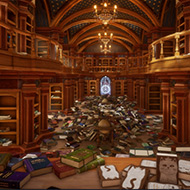
In Librarian: Tidy Up the Arcane Library, you start with every ability locked, a two-story building covered floor to ceiling in loose volumes, and a Principal who has already told you that you’re not leaving until all 3,072 books are shelved — that starting condition shapes almost every decision you’ll make for the rest of the run.
| Genre |
Organization simulation |
| Platform |
PC |
| Release year |
2026 |
| Core mechanic |
Sort scattered books into correct shelf categories using clues and unlockable magic |
Where You Start in Librarian: Tidy Up the Arcane Library
There’s no tutorial dungeon or slow ramp-up here. The moment control transfers to you, the floor is already buried, and the only guidance is a shelf map near the entrance that lists categories by code rather than by name. Figuring out that 1A means monsters or that 2K means jurisprudence is part of the challenge, not something the game hands you outright.
This blank-slate opening is why so many first-time players describe the early minutes as overwhelming rather than relaxing, despite the game’s reputation as a calm, low-stakes simulation. You have no sprint, no high jump, and no magic — just walking speed and your own reading comprehension against a room that looks genuinely chaotic.
Players who enjoy methodical, checklist-driven progress tend to thrive in this opening stretch, deliberately ignoring efficiency in favor of understanding the map fully before committing to a sorting order. Players chasing a fast completion time, by contrast, often burn their first ten minutes just scouting rather than shelving anything at all, treating the opening as reconnaissance rather than progress.
The Two-Floor Layout and Why It Matters
The first floor is weighted toward fantasy staples — magic and monster categories dominate the shelving codes there, which makes it the natural place to build early momentum since these sections tend to have the most visually distinct covers. The second floor is where things get harder: history, daily life, fiction, otherworld travel, dungeons, and language categories all sit close together, and their covers are far easier to confuse at a glance.
Once you’ve cleared a meaningful chunk of the first floor, the temptation is to charge upstairs immediately. Most experienced players resist that instinct, since the second floor rewards a slower, more deliberate read of each title rather than the pattern-matching-by-color approach that works fine downstairs.
The acoustic design tracks this progress in a way that’s easy to miss on a first playthrough: as more shelves fill in, the library’s ambient hum and background music shift, growing slightly richer, so the building itself feels less abandoned the closer you get to finishing a floor.
Sorting by Series Instead of by Pile
The single biggest adjustment new players have to make is abandoning pile-by-pile sorting in favor of series-by-series sorting. Books belonging to the same series need to be grouped and placed in correct volume order, not just dropped into the right general category, which means a shelf can look complete and still refuse to turn blue if one volume is out of sequence.
Community guides are blunt about the fix: pick one recognizable series, gather every copy you can see across the room, place it correctly, and only then move to the next series. Grabbing whatever’s nearest regardless of series is the single most common reason players end up backtracking across the entire library near the end of a run.
Split series cause a specific and recognizable frustration players sometimes call “the phantom volume” in community discussions — a shelf that appears full but stays unmarked because one copy of that series is sitting in a completely different pile on the other side of the room, sometimes on the floor you’ve already technically finished.
The Chest Keys and What They Actually Unlock
Four hidden chest keys are scattered through the library, and finding them is what unlocks sprint and high jump — movement upgrades that sound minor until you’re crossing between the first floor’s magic sections and the second floor’s language shelves dozens of times in a single run. Without them, that travel time adds up into a real drag on pacing, especially once shelving alone stops feeling like the bottleneck.
Rushing the keys before committing seriously to any shelving system is one of the most consistent pieces of advice across guides, since every minute spent walking at base speed later in the run is a minute you could have saved by prioritizing movement upgrades early.
Once high jump is unlocked, previously awkward layout quirks — narrow gaps between shelf rows, elevated sections you’d otherwise have to walk around — stop being obstacles, which changes how efficiently you can bounce between series scattered across different parts of the same floor.
Anti-Magic Master Versus the Efficiency Run
Three magical abilities eventually become available: Assemble, which summons every other volume of a series into your hands at once; Insight, which highlights matching volumes across a messy pile so they’re easy to spot; and Auto-Shelving, which places whatever you’re carrying onto its shelf in perfect order instantly. Together they turn the back half of the library from a search problem into something closer to a management problem.
The Anti-Magic Master achievement asks you to finish the entire game without touching any of the three, which sits in direct tension with the Efficiency Librarian achievement, earned by completing all 400 rows within three hours. You cannot realistically chase both in the same run, and which one a player attempts tends to say a lot about why they picked up Librarian: Tidy Up the Arcane Library in the first place.
Beyond those two, the Grand Librarian achievement for completing all 400 rows, and Overtime Avoider, earned by using your ultimate skill correctly in the post-game Special Stage, round out the achievement list. Reaching Overtime Avoider requires finishing the main library first and then opening the Special Stage from the title menu, a step easy to miss since nothing in the main game explicitly points you toward it.
Librarian: Tidy Up the Arcane Library and Its Imitators
Part of what makes discussion around this game interesting is a wave of near-identical competitors that followed its release, most notably a game replacing books with bottles on an altered map while keeping the same control scheme, color coding, and overall premise intact. Players who’ve spent real time in Librarian: Tidy Up the Arcane Library tend to notice the copy immediately, since the shelving logic and pacing feel lifted almost wholesale.
That comparison isn’t just trivia — it’s a useful way to understand what actually makes the original hold up. The series-based sorting, the four-key movement unlock, and the tension between the Anti-Magic Master and Efficiency Librarian achievements are specific enough design choices that a surface-level clone rarely replicates the balance between them, even when the visuals are swapped out convincingly.
Save data itself has become part of the ongoing conversation too, since a manual save and load system replaced the older autosave setup, storing progress in a GameData.sav file and prompting most returning players to migrate old saves the first time they relaunch after an update.
Whether you’re rushing toward Efficiency Librarian or deliberately avoiding every ability to lock in Anti-Magic Master, the shelf-by-shelf tension between speed and accuracy is what Librarian: Tidy Up the Arcane Library is actually testing, long after the initial panic of that first buried floor wears off.